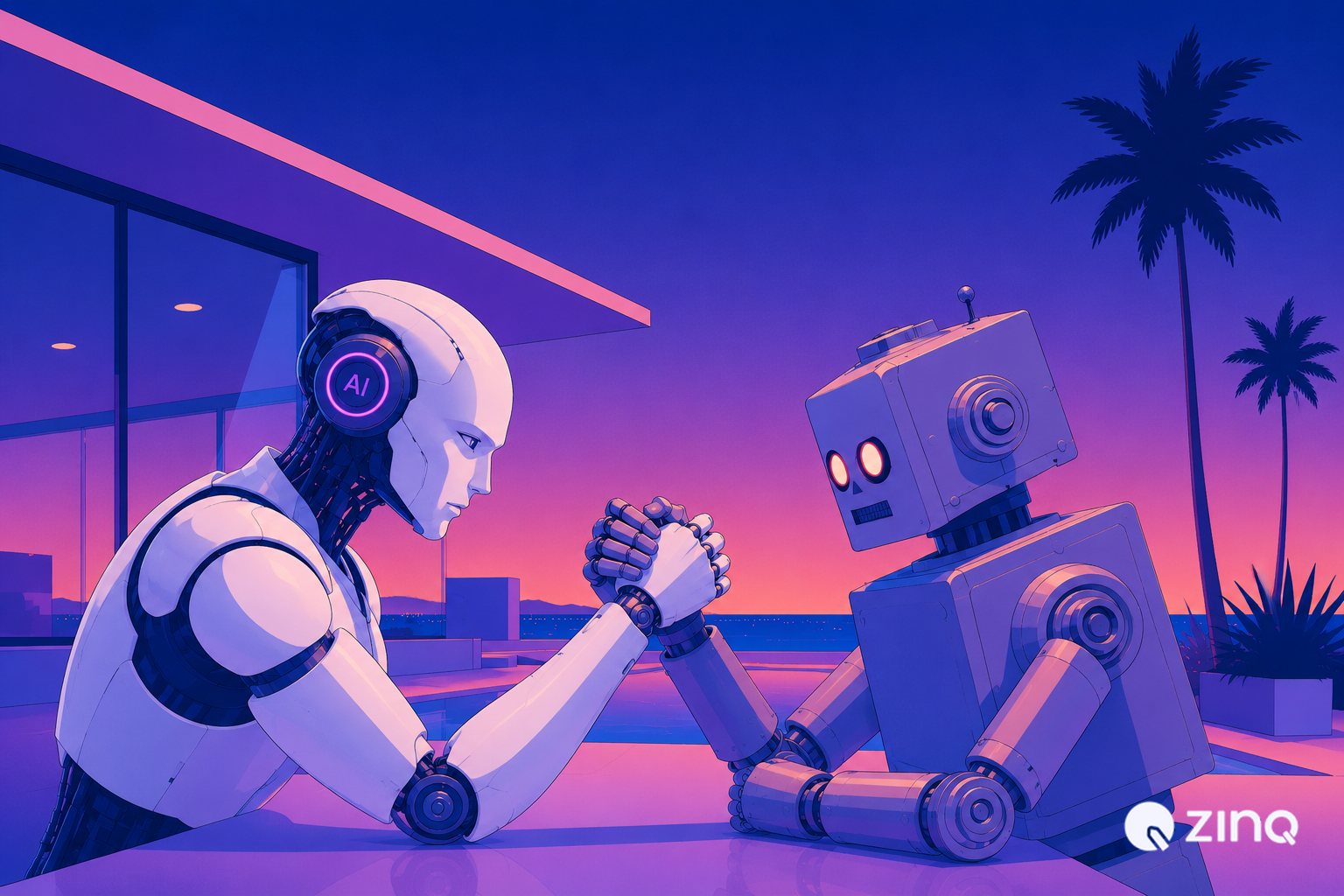
Artificial intelligence has transformed the way businesses interact with customers. When comparing an AI agent vs chatbot, it becomes clear that from answering common questions to automating workflows, AI-powered tools are becoming an important part of daily operations. However, many people still use the terms interchangeably, even though they are not the same thing.
Understanding the exact dynamics of an AI agent vs chatbot framework is important for businesses looking to improve customer support, streamline operations, and deliver better customer experiences.
In this article, we’ll explore the real difference between AI agents and chatbots, how they work, and when businesses should use each solution.
What Is a Chatbot?
A chatbot is a software application designed to simulate conversations with users. Traditional chatbots typically follow predefined rules, scripts, or decision trees to respond to questions and requests.
How Traditional Chatbots Work
Most chatbots are programmed with a set of predefined responses. They identify keywords or follow specific conversation paths to provide answers.
For example, if a customer asks about business hours, a chatbot can instantly provide the correct information. If the question falls outside its programmed responses, the chatbot may struggle to provide a useful answer.
Because of this limitation, chatbots are best suited for repetitive and predictable interactions.
Common Uses of Chatbots
Many businesses use chatbots to handle routine customer inquiries and reduce support workloads. Common use cases include:
- Answering frequently asked questions
- Providing order status updates
- Booking appointments
- Collecting basic customer information
- Routing inquiries to the correct department
Chatbots can improve response times, but their capabilities are usually limited to the scenarios they have been trained or programmed to handle.
What Is an AI Agent?
An AI agent is a more advanced system that can understand context, make decisions, complete tasks, and take actions on behalf of users.
Unlike traditional chatbots, AI agents are not limited to predefined conversation flows. They can analyze information, learn from interactions, and connect with multiple business systems to complete complex tasks.
How AI Agents Work
AI agents use advanced artificial intelligence models to understand intent, context, and user goals. Instead of simply matching keywords, they interpret the meaning behind conversations.
For example, if a customer wants to change an appointment, update account information, and ask about billing in the same conversation, an AI agent can manage all of these requests while maintaining context throughout the interaction.
This allows businesses to automate more complex processes without requiring human intervention for every step.
Key Capabilities of AI Agents
AI agents can perform actions rather than simply provide answers.
These capabilities may include:
- Understanding natural language
- Maintaining conversation context
- Accessing company databases
- Managing support tickets
- Qualifying leads
- Scheduling appointments
- Triggering workflow automation
- Escalating issues to human agents when needed
Because of these abilities, AI agents can serve as digital team members rather than simple conversational tools.
AI Agent vs Chatbot: The Key Differences
Understanding the differences between AI agents and chatbots helps businesses choose the right solution for their needs.
Decision-Making Ability
Traditional chatbots follow predefined rules. They cannot independently make decisions outside their programmed logic.
AI agents can analyze situations, evaluate options, and determine the best action based on available information. This allows them to handle more dynamic and complex interactions.
Context Awareness
Most chatbots have limited memory and context retention. They often treat each interaction as a separate request.
AI agents maintain context throughout conversations. They can understand previous messages, remember user preferences, and provide more personalized responses.
This creates a smoother customer experience and reduces frustration.
Task Execution
Chatbots primarily provide information.
AI agents can take action.
For example, a chatbot may explain how to reset a password. An AI agent can verify the user’s identity and initiate the password reset process automatically.
This difference significantly improves operational efficiency.
Learning and Adaptability
Traditional chatbots require manual updates when business processes change.
AI agents are more adaptable. They can work with large amounts of information, learn from interactions, and continuously improve their performance over time.
This makes them better suited for evolving business environments.
When Should Businesses Use a Chatbot?
Chatbots can still provide value when businesses have simple support requirements and limited automation needs.
Suitable Use Cases for Chatbots
A chatbot may be sufficient when businesses need to:
- Answer basic questions
- Provide business information
- Collect contact details
- Handle simple customer inquiries
- Support low-volume customer interactions
For smaller organizations with predictable customer questions, chatbots can offer a cost-effective starting point.
Limitations Businesses Should Consider
As customer expectations increase, chatbot limitations become more noticeable.
Customers often expect personalized support, fast problem resolution, and natural conversations. When chatbots fail to understand context or complete tasks, users may become frustrated.
This can lead to lower customer satisfaction and increased support escalations.
When Should Businesses Use an AI Agent?
AI agents are ideal for businesses that want to automate complex workflows and deliver more advanced customer experiences.
Customer Support Automation
AI agents can handle support requests from start to finish. They can retrieve account information, update records, create support tickets, and resolve common issues without human assistance.
This reduces response times while improving service quality.
Lead Qualification and Sales Support
Businesses often lose opportunities because leads are not contacted quickly enough.
AI agents can engage website visitors instantly, qualify leads, collect important information, and route prospects to the appropriate sales team member.
This helps improve conversion rates and ensures faster follow-up.
Workflow Automation
One of the biggest advantages of AI agents is their ability to automate workflows.
Instead of simply answering questions, AI agents can trigger actions across multiple systems. They can update customer records, notify team members, schedule appointments, and manage operational processes.
This creates significant productivity gains across the organization.
How AI Agents Improve Website Performance
Businesses often focus on attracting website traffic but overlook what happens after visitors arrive.
Better Visitor Engagement
AI agents engage visitors in real time and provide immediate assistance. This keeps users engaged and increases the likelihood of meaningful interactions.
Longer engagement often leads to better conversion opportunities.
Improved Lead Capture
Many website visitors leave without filling out forms or contacting the business.
AI agents can proactively start conversations, answer questions, and collect lead information while visitors are actively exploring the website.
This helps businesses capture opportunities that might otherwise be lost.
Enhanced Customer Experience
Fast responses are now expected by customers.
AI agents provide instant support around the clock, helping businesses deliver consistent customer experiences regardless of time zones or support availability.
This can improve customer satisfaction and strengthen brand trust.
Common Mistakes
One common mistake is assuming that all conversational AI tools are the same. Many businesses implement basic chatbots expecting advanced automation capabilities and become disappointed with the results.
Another mistake is focusing only on answering customer questions instead of automating complete workflows. Modern businesses often need solutions that can take action, not just provide information.
Finally, businesses sometimes delay adopting AI agents because they believe implementation is too complex. In reality, many modern AI platforms make it easier than ever to automate support, lead management, and operational tasks.
Frequently Asked Questions
What is the main difference between an AI agent and a chatbot?
A chatbot primarily responds to questions using predefined rules or scripts. An AI agent can understand context, make decisions, complete tasks, and automate workflows across multiple systems.
Are AI agents better than chatbots?
AI agents offer more advanced capabilities than traditional chatbots. However, the best choice depends on business needs. Simple support tasks may only require a chatbot, while complex customer interactions and workflow automation benefit from AI agents.
Can AI agents replace customer support teams?
AI agents can automate many routine support tasks, but human support teams still play an important role in handling complex, sensitive, or high-value interactions. The most effective approach is often a combination of AI automation and human expertise.
How do AI agents help businesses generate more leads?
AI agents can engage website visitors instantly, answer questions, qualify prospects, and collect lead information. This helps businesses respond faster and improve conversion rates.
Do AI agents improve customer experience?
Yes. AI agents provide instant responses, personalized interactions, and faster issue resolution. This creates a smoother customer experience and reduces customer frustration.
Final Thoughts
Ultimately, looking at an AI agent vs chatbot setup goes far beyond technology terminology. While chatbots are useful for handling simple conversations, AI agents are designed to understand context, make decisions, and complete meaningful business tasks.
As customer expectations continue to rise, businesses need solutions that can do more than answer questions. AI agents help automate workflows, improve customer support, capture more leads, and increase operational efficiency.
For organizations looking to scale support operations and create better customer experiences, AI agents represent the next evolution of business automation. By combining conversational intelligence with real action-taking capabilities, they offer a powerful way to transform how businesses interact with customers and manage daily operations.
Artificial intelligence has transformed the way businesses interact with customers. When comparing an AI agent vs chatbot, it becomes clear that from answering common questions to automating workflows, AI-powered tools are becoming an important part of daily operations. However, many people still use the terms interchangeably, even though they are not the same thing.
Understanding the exact dynamics of an AI agent vs chatbot framework is important for businesses looking to improve customer support, streamline operations, and deliver better customer experiences.
In this article, we’ll explore the real difference between AI agents and chatbots, how they work, and when businesses should use each solution.
Leave a Reply